
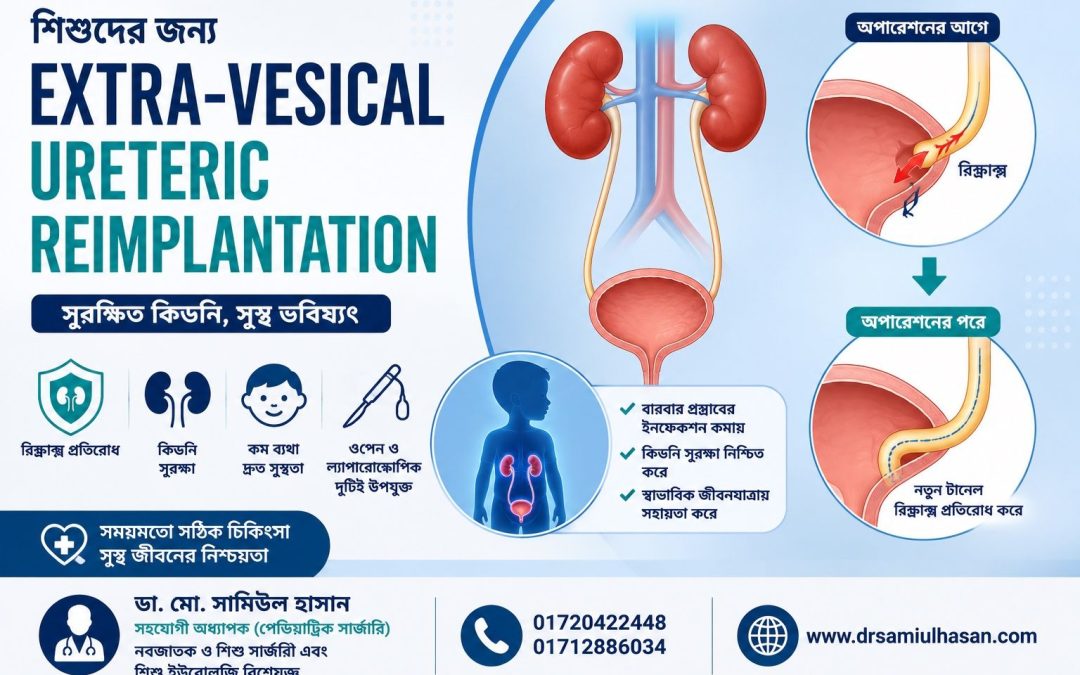
What is Extra-vesical Ureteric Reimplantation?
Extra-vesical ureteric reimplantation is a surgical procedure performed to correct abnormalities at the junction between the ureter and the urinary bladder. The operation creates a new submucosal tunnel for the ureter to prevent backward flow of urine (vesicoureteral reflux) while preserving normal drainage from the kidney to the bladder.
Unlike intravesical techniques, this procedure is performed without opening the bladder from inside, making it less invasive to the bladder itself.
One of the most commonly used extra-vesical techniques is the Lich-Gregoir procedure.
What Problems Require This Surgery?
1. Vesicoureteric Reflux (VUR) is the most common indication.
In VUR, urine flows backward from the bladder toward the kidneys, increasing the risk of: Recurrent urinary tract infection (UTI), Pyelonephritis, Renal scarring, Long-term kidney damage
2. Primary Obstructed Megaureter: Some children have narrowing at the lower end of the ureter causing obstruction and progressive dilatation.
3. Failed Previous Anti-reflux Procedures: Redo surgery may be required in selected children.
4. Selected Duplex System Abnormalities: Certain duplicated ureter conditions may require ureteric reimplantation.
Principle of the Operation: The ureter enters the bladder through a tunnel within the bladder wall.
If this tunnel is too short or abnormal, reflux can occur.
The surgery works by: Mobilizing the ureter, Creating a longer tunnel in the bladder wall, finally Reimplanting the ureter in a tension-free manner. This creates a valve-like mechanism that prevents reflux during bladder filling and voiding.
Surgical Approaches:
1. Open Extra-vesical Reimplantation
Traditionally performed through a lower abdominal incision. Advantages are – Excellent success rate, Familiar and reproducible technique, Suitable for complex anatomy, Good long-term outcomes
Limitations are- Larger incision, More postoperative pain, Longer recovery
2. Laparoscopic Extra-vesical Reimplantation
Performed through small ports using a camera and specialized instruments. Advantages are – Smaller scars, Less pain, Faster recovery, Earlier mobilization, Better cosmetic outcome, Reduced hospital stay
Challenges are- Technically demanding, Requires advanced pediatric laparoscopic expertise, Intracorporeal suturing in small children can be difficult
Why is Extra-vesical Technique Popular?
Compared with intravesical reimplantation, extra-vesical techniques offer several advantages- Less bladder manipulation, Less bladder spasm, Reduced hematuria, Earlier catheter removal, Faster recovery, Less postoperative discomfort
Are There Any Risks?
As with any surgery, complications may occur.
Possible risks include: Temporary urinary retention, Persistent reflux, Ureteric obstruction, Urinary tract infection, Bleeding, Need for redo surgery (rare)
The risk of urinary retention is higher in bilateral extra-vesical repair due to possible pelvic nerve irritation.
How are Risks Reduced?
Modern pediatric urology practice minimizes risks by: Careful patient selection, Detailed imaging evaluation, Nerve-sparing surgical technique, Gentle tissue handling, Experienced pediatric urology team, Proper postoperative follow-up
Long-Term Outcome
Most children achieve: Resolution of reflux, Reduced UTI episodes, Preservation of kidney function, Better quality of life
Long-term follow-up remains important to monitor: Kidney growth, Renal scarring, Bladder function, Recurrence of infection
Final Message
Extra-vesical ureteric reimplantation is an effective and widely accepted surgical option for children with vesicoureteral reflux and selected ureteric abnormalities. With advances in minimally invasive surgery, many children can now benefit from excellent outcomes with smaller scars and faster recovery.
Timely diagnosis, proper evaluation, and expert pediatric urological care are essential for protecting long-term kidney health.
Dr. Md Samiul Hasan
Associate Professor (Pediatric Surgery)
Neonatal & Pediatric Surgery and Pediatric Urology Specialist