
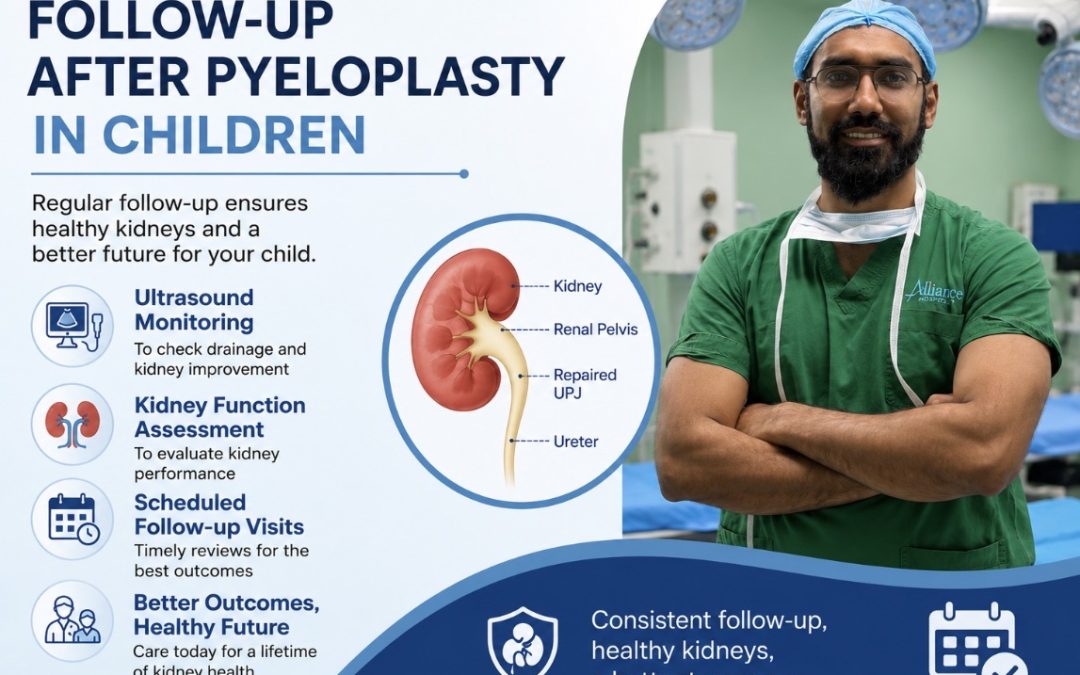
Introduction
Pyeloplasty is the standard surgical treatment for Pelvi-Ureteric Junction (PUJ) Obstruction, one of the most common causes of hydronephrosis in children. Modern open, laparoscopic, and robotic pyeloplasty have excellent success rates, with more than 90–95% of children achieving good outcomes.
However, the operation is only one part of the treatment. Regular follow-up is equally important to ensure that the kidney continues to recover and function normally.
Why Is Follow-up Necessary?
After surgery, the kidney does not return to normal overnight.It needs time to Recover from long-standing obstruction,Improve urinary drainage,Regain or preserve kidney function,Reduce hydronephrosis gradually.
Regular follow-up allows your surgeon to confirm that healing is progressing as expected.
What Is Checked During Follow-up?
1. Clinical Assessment
During each visit,we check Pain or discomfort,Fever, Urinary tract infections,Difficulty passing urine,General growth and well-being of the child.
Most children remain completely symptom-free after successful surgery.
2. Ultrasound Examination
Ultrasound is the most important investigation during follow-up.It helps evaluate Degree of hydronephrosis,Kidney size,Thickness of the kidney tissue,Presence of any new obstruction.
Parents should remember that hydronephrosis often improves gradually over several months or even years.A mildly dilated kidney on ultrasound does not always mean the operation has failed.
3. Renal Scan (MAG-3 or DTPA)
In selected children, a renal scan may be recommended.This helps assess Drainage of urine,Split renal function,Improvement compared with preoperative studies.Not every child requires repeated renal scans.
4. Kidney Function Tests
Blood tests are usually needed only in selected patients, especially those with Bilateral disease,Solitary kidney,Poor renal function,Complex urinary tract anomalies.
When Should Follow-up Be Done?
Although the schedule may vary depending on the child’s condition, a typical follow-up plan includes-
1. 2–4 weeks: Wound review and recovery assessment
2. Around 3 months: Ultrasound examination
3. Around 6 months: Clinical review ± imaging
4. Around 12 months: Ultrasound and, if indicated, renal scan
5. Yearly follow-up: Selected patients with persistent hydronephrosis or complex conditions
Each childrequire a individualize schedule according to the child’s progress.
What Should Parents Watch for?
If your child develops Fever,Flank or abdominal pain,Recurrent urinary tract infection,Vomiting associated with pain,Blood in urine,Decreased urine output.
These symptoms do not always indicate recurrent obstruction but require prompt evaluation.
Does Hydronephrosis Disappear Completely?
Not always.Many children continue to have mild hydronephrosis despite successful surgery.
What matters most is Good drainage,Stable kidney function,No symptoms,No progressive deterioration.Therefore, treatment decisions should never be based on ultrasound alone.
Can PUJ Obstruction Recur?
Recurrence is uncommon but possible.
Most recurrences occur within the first two years after surgery.Regular follow-up allows early detection and timely treatment if necessary.
Long-term Outlook
The vast majority of children who undergo successful pyeloplasty Lead completely normal lives,Have preserved kidney function,Participate in sports and normal activities,Require no long-term restrictions.
Early diagnosis, expert surgery, and proper follow-up together provide the best long-term outcome.
Pyeloplasty is not the end of treatment—it is the beginning of your child’s recovery.
Regular follow-up, scheduled ultrasound examinations, and timely review by your pediatric surgeon help to ensure that the operated kidney continues to function well throughout childhood.
Your child’s future kidney health depends not only on a successful operation but also on careful long-term monitoring.
Dr. Md. Samiul Hasan
Associate Professor (Pediatric Surgery)
Bangladesh Shishu Hospital & Institute
🌐 www.drsamiulhasan.com