
What Is an Inguinal Hernia?
An inguinal hernia occurs when a small opening in the groin area allows abdominal contents to protrude into the inguinal canal. It is one of the most common surgical conditions in children and usually requires an operation because it does not heal on its own.
Although the condition may look similar in boys and girls, the anatomy is different, making some parts of the operation uniquely challenging in each sex.
Why Does a Child Develop an Inguinal Hernia?
Before birth, a natural passage called the processus vaginalis helps structures descend through the groin. Normally, this passage closes shortly after birth.
If it remains open, abdominal contents can pass through the opening and form a hernia.
Common Symptoms
Parents may notice:
A swelling in the groin
A swelling extending into the scrotum in boys
Swelling that appears during crying or straining
Intermittent swelling that disappears during sleep
Because a hernia can become trapped (incarcerated), surgery is usually recommended soon after diagnosis.
The Goal of Surgery
The objective of surgery is simple:
Close the abnormal opening, Prevent recurrence, Avoid injury to important structures, Prevent future complications
However, achieving these goals requires careful attention to different anatomical structures in boys and girls.
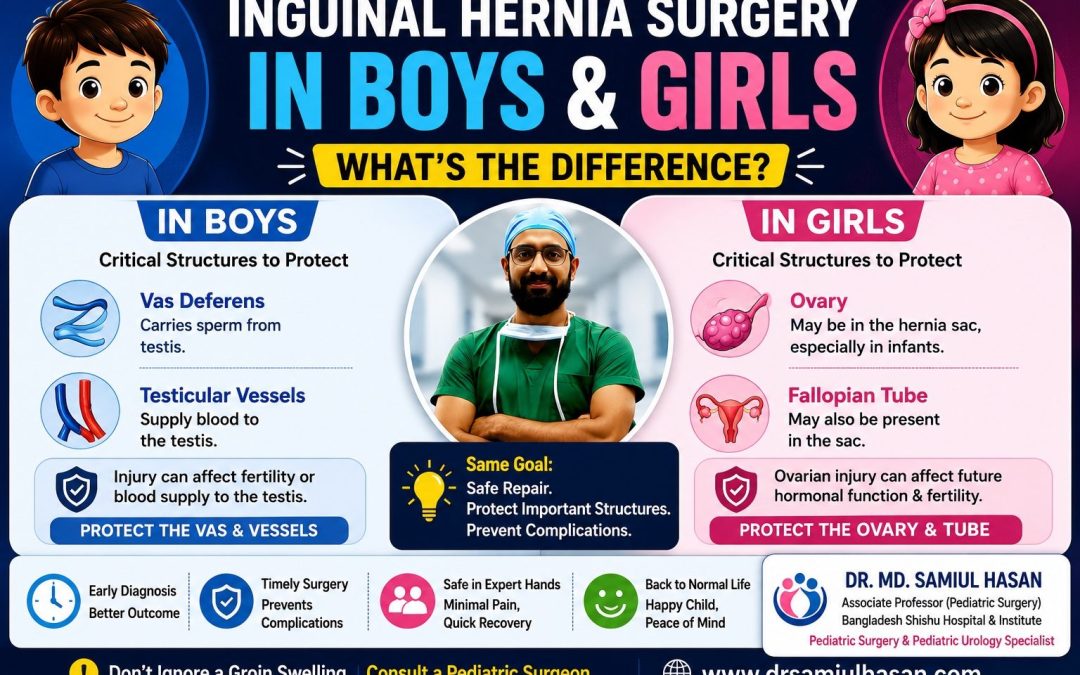
Inguinal Hernia Surgery in Boys: The Critical Structures-In boys, the hernia sac lies very close to: The vas deferens (the tube carrying sperm),The testicular blood vessels.
These structures are delicate and closely attached to the hernia sac, especially in infants and young children.
Why Is This Important?
The most critical step of the operation is separating the hernia sac from these structures without causing injury. Damage to the vas deferens may affect future fertility.
Damage to the testicular blood vessels may compromise blood supply to the testis and, in rare cases, lead to testicular atrophy.
For this reason, pediatric hernia surgery requires meticulous dissection and knowledge of pediatric anatomy.
Inguinal Hernia Surgery in Girls: The Critical Structures- In girls, the hernia sac may contain Ovary, Fallopian tube, Occasionally part of the uterus. This is particularly common in infants.
Why Is This Important?
An ovary trapped inside the hernia can lose its blood supply if treatment is delayed.
This may result in: Ovarian torsion, Ovarian damage, Loss of ovarian function.
Therefore, when a girl presents with an inguinal hernia, special attention is paid to identifying and safely reducing the ovary before repairing the hernia.
Why Early Surgery Is Important
Early repair helps prevent,Incarceration (trapped hernia), Intestinal obstruction, Ovarian injury in girls, Emergency surgery, Increased surgical difficulty.
Elective surgery is generally safer and easier than emergency surgery.
Is the Operation Safe? Yes.
In experienced pediatric surgical hands, inguinal hernia repair is one of the safest and most successful operations performed in children.
Most children:
Go home the same day or the next day
Resume normal activities quickly
Experience minimal discomfort
Have an excellent long-term outcome
Final Message for Parents
Although inguinal hernia surgery may appear straightforward, the operation requires careful protection of different structures in boys and girls.
Remember:
In boys: Protecting the vas deferens and testicular vessels is critical.
In girls: Protecting the ovary and fallopian tube is critical.
Early diagnosis and timely surgery provide the best outcomes and help prevent avoidable complications.
⸻
Dr. Md Samiul Hasan
Associate Professor (Pediatric Surgery)
Bangladesh Shishu Hospital & Institute