
Undescended testis (UDT), or cryptorchidism, is one of the most common congenital anomalies in male children. While many testes can be palpated in the groin, a subset remains non-palpable, making diagnosis and management more challenging.
In such cases, laparoscopy plays a crucial role—both as a diagnostic and therapeutic tool.
When Do We Need Laparoscopy?
Laparoscopy is primarily indicated in non-palpable testis, especially when:
Indications:
- Testis is not palpable on clinical examination (even under anesthesia)
- Suspected intra-abdominal testis
- Previous failed inguinal exploration
- Uncertain diagnosis (e.g., absent vs atrophic testis)
- Bilateral non-palpable testes (to rule out disorders of sexual development)
Key Point:
If the testis cannot be felt clinically, laparoscopy is the gold standard investigation.
Why Laparoscopy?
- Provides direct visualization
- Avoids unnecessary open exploration
- Allows simultaneous diagnosis and treatment
- Minimally invasive with faster recovery
Possible Findings During Laparoscopy
During laparoscopy, several scenarios may be encountered:
1. Intra-abdominal Testis-
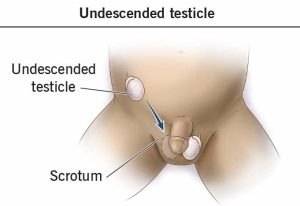
Absence of testis in its normal position in scrotum
The testis is located inside the abdomen, usually near the internal ring.
- Low intra-abdominal testis → Primary laparoscopic orchiopexy
- High intra-abdominal testis → Two-stage Fowler-Stephens orchiopexy
2. Blind-ending Vas and Vessels
(“Vanishing testis”)
Vas deferens and testicular vessels end blindly inside abdomen – Testis likely atrophied antenatally Management:
- No further surgery required
- Reassure parents
3. Vas and Vessels Enter Internal Ring. Structures pass into inguinal canal- Testis is likely in the inguinal canal or atrophic nubbin
Management:
- Inguinal exploration
- Remove testicular remnant (if present)
4. Absent Vas and Vessels, No identifiable structures.
- True agenesis (rare)- Management: No surgical intervention needed
5. Peeping Testis- Testis intermittently enters internal ring.
Management: Laparoscopic Orchiopexy
Importance of Timely Management:
Early treatment is essential because delayed management may lead to: Infertility, Increased risk of testicular malignancy, Psychological impact,Testicular torsion risk
Best time for surgery: Between 6 months to 1 year of age
Long-Term Outcomes
With timely and appropriate laparoscopic management:
Testis can be positioned in scrotum
Better fertility potential
Easier surveillance for malignancy
Improved cosmetic and psychological outcomes
Take-Home Message
- Non-palpable testis = Laparoscopy is essential
- It is both diagnostic and therapeutic
- Management depends on intraoperative findings
- Early surgery ensures best outcomes for the child
Modern pediatric surgery has made management of undescended testis safe, effective, and minimally invasive. Awareness among parents and early referral to a pediatric surgeon can make a lifelong difference in a child’s health.
Dr. Md Samiul Hasan
Associate Professor (Pediatric surgery)
Neonatal & pediatric surgery and pediatric urology specialist
Chembar: Alliance Hospital Limited ,,Ring Road, Shyamoli, Dhaka .01720422448,
Apollo Clinic Bangladesh
64, Satmasjid Road , Dhanmondi, Dhaka
09677444222