
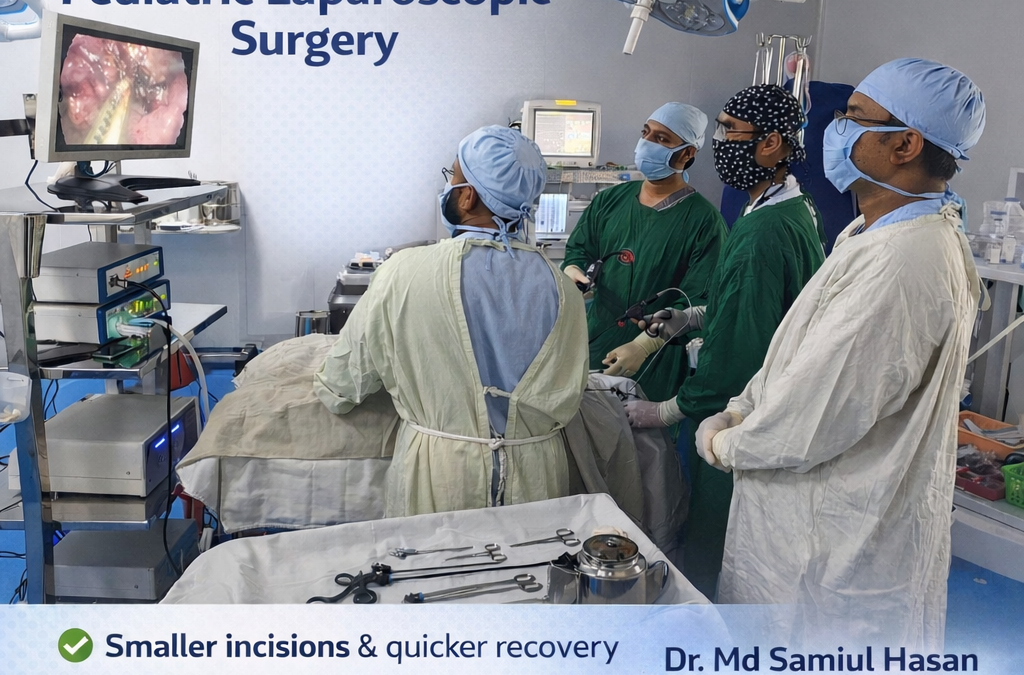
Modern surgery for children has changed dramatically over the last two decades. Today, many urinary problems in children can be treated through Minimal Invasive Surgery (MIS) — also called keyhole surgery or laparoscopic surgery. Instead of making a large cut, surgeons perform the operation through very small openings using a camera and delicate instruments.
For parents, this often means:
- Less pain
- Smaller scars
- Faster recovery
- Shorter hospital stay
- Earlier return to normal life
In pediatric urology, minimal invasive surgery is becoming increasingly important because children need gentle, precise, and safe treatment.
What Is Pediatric Urology?
Pediatric urology deals with diseases of the urinary system and genital organs in children. These include:
- Kidney problems
- Swollen kidneys (hydronephrosis)
- Urinary blockage
- Vesicoureteric reflux (urine going backward to the kidney)
- Undescended testes
- Kidney stones
- Some bladder problems
- Certain congenital abnormalities present since birth
Many of these conditions previously required large operations. Now, many can be treated with minimal invasive techniques.
What Is Minimal Invasive Surgery?
In minimal invasive surgery, a tiny camera is inserted through a small opening. The camera shows the inside of the body on a monitor. Special instruments are then used to perform the operation.
Common techniques include:
- Laparoscopy – surgery through small cuts in the abdomen
- Thoracoscopy – surgery inside the chest
- Endoscopy/Cystoscopy – using small cameras through natural urinary passages without cuts
The cuts are usually only 3–5 mm in children.
Common Pediatric Urology Operations Done by Minimal Invasive Surgery
1. Pyeloplasty for Hydronephrosis
Hydronephrosis means swelling of the kidney due to blockage of urine flow. Laparoscopic pyeloplasty can correct this blockage with excellent success.
Benefits:
- Smaller scar
- Less pain
- Faster recovery
2. Undescended Testis Surgery
Sometimes a testis remains inside the abdomen and cannot be felt from outside. Laparoscopy helps surgeons locate the testis accurately and treat it safely.
3. Kidney Removal (Nephrectomy)
A badly damaged or non-functioning kidney may need removal. Laparoscopic nephrectomy is now widely used in children.
Children usually:
- Recover faster
- Need less pain medicine
- Stay fewer days in hospital
4. Kidney Stone Treatment
Some kidney or ureteric stones in children can be treated using endoscopic or minimally invasive procedures without large cuts.
5. Diagnostic Procedures
Sometimes scans cannot clearly explain a child’s problem. Laparoscopy allows doctors to directly see inside the abdomen and diagnose certain conditions accurately.
6. Cystoscopy for bladder and urethral anomaly (Posterior urethral valve)
Why Is Minimal Invasive Surgery Important for Children?
Children are not small adults. Their bodies are delicate, and they recover differently. Minimal invasive surgery offers several important advantages:
Less Pain
Small cuts cause less tissue injury. Children usually feel more comfortable after surgery.
Smaller Scars
Tiny scars are cosmetically better and may reduce psychological stress later in life.
Faster Recovery
Most children can eat, move, and play earlier after surgery.
Shorter Hospital Stay
Many children can go home earlier, reducing hospital costs and family stress.
Lower Risk of Some Complications
Smaller wounds may reduce infection risk and wound-related problems.
Is Minimal Invasive Surgery Safe?
Yes — when performed by trained pediatric surgeons with proper equipment, minimal invasive surgery is considered very safe.
However, not every child or every disease is suitable for MIS. Some complex conditions may still require open surgery. The surgeon decides the best approach based on:
- Child’s age and weight
- Disease type
- Severity of the condition
- Available facilities and expertise
Challenges in Bangladesh and LMICs
In countries like Bangladesh, minimal invasive pediatric surgery is growing rapidly, but challenges still exist:
- High cost of equipment
- Need for specialized training
- Limited availability outside major cities
- Lack of awareness among parents
Despite these challenges, more hospitals are now offering pediatric laparoscopic and endoscopic services than before.
The Future of Pediatric Urology Surgery
The future is moving toward:
- More precise surgery
- Better cameras and instruments
- Smaller scars
- Faster recovery
- Less suffering for children
Robotic surgery is also emerging in some countries, though it is still limited in many developing nations.
A Message for Parents
If your child has a urinary or kidney problem, do not panic. Many conditions can now be treated safely with advanced minimally invasive techniques.
Early diagnosis and timely consultation with a trained pediatric surgeon or pediatric urologist are very important. Delaying treatment may sometimes damage the kidneys permanently.
Children deserve specialized care, gentle surgery, and compassionate treatment.
Dr. Md Samiul Hasan
Associate Professor, Pediatric Surgery
Neonatal, Pediatric & Pediatric Urology Specialist