
Over the last two decades, pediatric surgery has advanced significantly. One of the most important innovations is laparoscopic surgery, also known as minimally invasive surgery. This technique allows surgeons to perform many operations through very small incisions using a camera and specialized instruments.
For children, this approach offers several advantages compared with traditional open surgery, including less pain, quicker recovery and better cosmetic results.
What is Pediatric Laparoscopic Surgery?
Pediatric laparoscopic surgery is a surgical technique where a tiny camera called a laparoscope is inserted through a small incision, usually only a few millimeters wide. The camera sends magnified images of the internal organs to a monitor in the operating room.
Using these images as guidance, the surgeon performs the operation using specialized instruments inserted through other small ports. This technique allows precise surgery while minimizing trauma to the child’s body.
Why Laparoscopic Surgery is Especially Beneficial for Children
Children recover differently from adults after surgery. Because their bodies are still developing, minimizing surgical trauma is very important.
Laparoscopic surgery offers several key advantages for pediatric patients.
Main Advantages of Pediatric Laparoscopic Surgery
1. Smaller Incisions: Traditional surgery often requires larger cuts. In laparoscopic surgery, the incisions are usually 3–5 mm in size.
This results in: minimal scarring, less tissue damage, and Faster wound healing.
2. Less Postoperative Pain: Because the incisions are smaller and tissues are less disturbed, children usually experience significantly less pain after surgery.
This often means: Reduced need for strong pain medications, Greater comfort for the child, and faster recovery.
3. Faster Recovery and Early Return to Normal Activities: One of the biggest benefits of laparoscopic surgery is quicker recovery.
Children can often Start feeding earlier, move comfortably sooner, and return home earlier than with traditional surgery
4. Lower Risk of Infection: Smaller incisions reduce exposure of internal tissues, which helps decrease the risk of postoperative infections.
5. Better Cosmetic Outcome: For children and parents, the cosmetic result after surgery can be important. Laparoscopic surgery leaves very small scars, which often become barely visible over time.
Common Pediatric Conditions Treated with Laparoscopic Surgery.
Today, many pediatric surgical conditions can be treated laparoscopically. Some common examples include:
Appendicitis, Inguinal hernia, Undescended testis, Ovarian cysts, Gall bladder disease, Some congenital abdominal conditions, Pediatric urology operations
Each case is carefully evaluated before deciding whether laparoscopic surgery is appropriate.
Pediatric laparoscopic surgery represents a major advancement in modern pediatric surgical care. With smaller incisions, reduced pain, quicker recovery and better cosmetic outcomes, it offers significant benefits for children.
Timely evaluation by a qualified pediatric surgeon ensures that children receive the most appropriate and safest treatment.
Dr. Md Samiul Hasan
Associate Professor (Pediatric Surgery)
Pediatric & Neonatal Surgery and Pediatric Urology Specialist
Bangladesh Shishu Hospital and Institute
Chembar:
Alliance Hospital
Ring Road, Shyamoli, Dhaka
Phone:
01720422448, 01712886034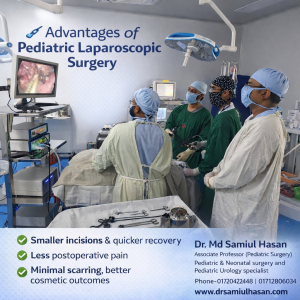
Website:
www.drsamiulhasan.com