
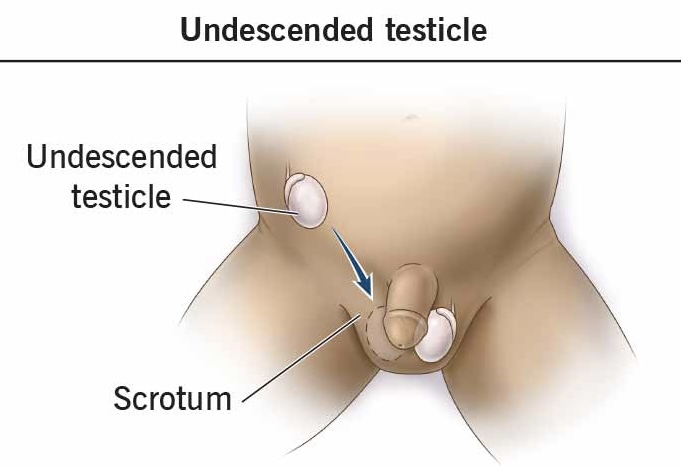
What is an Undescended Testis?
During pregnancy, a baby’s testes develop inside the abdomen and normally descend into the scrotum before birth. When one or both testes fail to reach the scrotum, the condition is called Undescended Testis (UDT) or Cryptorchidism.
It is one of the most common congenital conditions in boys, affecting about 2–4% of full-term newborns and an even higher proportion of premature infants. Many testes descend spontaneously during the first few months of life, but those that remain undescended after 6 months usually require evaluation by a pediatric surgeon.
Why Does It Matter?
If left untreated, an undescended testis may lead to Reduced testicular growth,Decreased fertility potential later in life,Increased risk of testicular torsion,Greater susceptibility to trauma,Increased lifetime risk of testicular cancer compared with the general population.
Early treatment significantly reduces these risks.
How Can Parents Recognize It?
Parents may notice that One or both sides of the scrotum appear empty. A testis cannot be felt during bathing or diaper changes.A small lump may occasionally be felt in the groin.
In most children, diagnosis is made by a careful physical examination.
Is Ultrasound Always Needed?
No. Routine ultrasound is usually unnecessary before referral. A thorough examination by an experienced pediatric surgeon is often sufficient. Additional imaging or laparoscopy may be required when the testis is non-palpable.
When Should Surgery Be Performed?
Current international guidelines recommend orchiopexy between 6 and 18 months of age if the testis has not descended by 6 months.
Earlier surgery offers the best chance of preserving normal testicular growth and future fertility.
What is Orchiopexy?
Orchiopexy is a safe and highly successful operation that moves the testis into the scrotum and secures it in its normal position. Most children go home on the same day or the following day.
What Happens After Surgery?
Children usually recover quickly. Thr growth of the testis is monitored in subsequent follow up .
When Should You Seek Medical Care?
Contact your pediatric surgeon if The testis has not descended after 6 months of age. The operated testis appears to move upward again.There is severe pain or swelling. The wound becomes red, drains pus, or is associated with fever.
Frequently Asked Questions
Can we wait and see?
After 6 months of age, spontaneous descent is uncommon. Delaying treatment may increase the risk of future complications.
Can medicines replace surgery?
Routine hormonal therapy is not recommended for most children. Orchiopexy remains the standard treatment.
Will my child have a normal life after surgery?
Yes. Most children recover completely and lead normal, active lives with appropriate follow-up.
An undescended testis should never be ignored. Early diagnosis and timely orchiopexy—ideally between 6 and 18 months of age—provide the best opportunity to protect testicular development, fertility potential, and long-term health.